







The tools you would switch to, Wayland already runs.
Claude Code, Codex, Cursor, Gemini, Copilot, Kimi, Goose, OpenCode, Grok, Qwen, Hermes and eight more. Nineteen agent CLIs, driven from one seat, on your keys. Wayland is not the thing you cannot leave. It is the thing that makes leaving everything else cheap.

Nineteen agents, one seat
Every major agent CLI, detected on install and driven from a single command center. The ones you would otherwise pick instead are on the list, not on the other side of a migration.

Models direct, no middleman
The engine speaks to around twenty providers itself, among them Anthropic, OpenAI, Bedrock, Vertex and Gemini, plus any OpenAI-compatible endpoint and local Ollama. Your traffic goes to them, not through us.

No account. No server. Nothing sent back.
Wayland sends us no telemetry, no analytics and no crash reports. You do not have to take that on trust: the error-reporting library it bundles only switches on with a build key we have never issued, so the compiler strips it out of the binary you run. The app needs no Wayland account and talks to no Wayland backend. (A website account exists only if you buy something from us.) Your profile is local, your keys sit in your OS keychain, and every conversation lives in a SQLite file on your own disk.

Licensed so you can actually leave
Apache-2.0 engine, AGPL-3.0 app. Fork it, embed it, or build commercial software on the engine. The exit is written into the licence rather than promised in a blog post.
The engine that runs everything. Including everyone else's.
Most desktop AI is a prettier window onto someone else's model. Wayland ships the engine itself: one self-contained Rust binary, with no Node or Python runtime to install. Every major provider, the built-in tools, MCP in both directions, a memory that survives the session, and an OS-native sandbox behind a single egress gate for everything the engine executes, all in the box. It does the work itself, and it drives Claude Code, Codex, Gemini, Kimi and fourteen more from the same seat. Every one of its 1,974 skills earned its place first: mutated into variants, scored, and kept only when it beat both the incumbent and its own parent. Then it keeps going on your machine. When the same kind of task succeeds three times running, it drafts a new skill from what worked. That loop is on by default.
- ✓ One Rust binary. No Node, no Python, nothing else to install
- ✓ Commands Claude Code, Gemini, Codex, Kimi, OpenClaw and 14 more. 19 agents, one seat
- ✓ Every major provider on your own keys, or fully local with Ollama
- ✓ 1,974 skills evolved before shipping, then it writes new ones from your wins
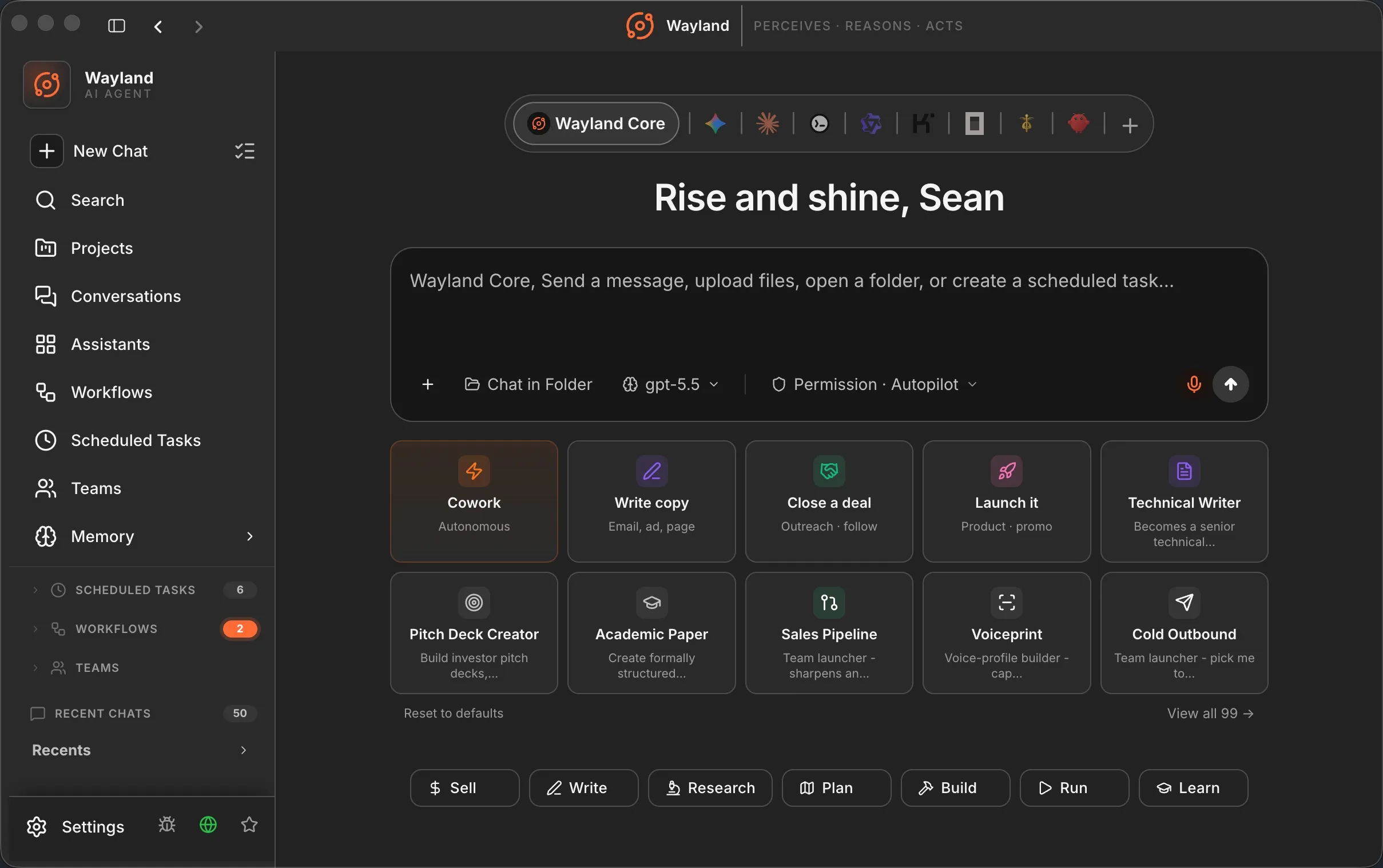
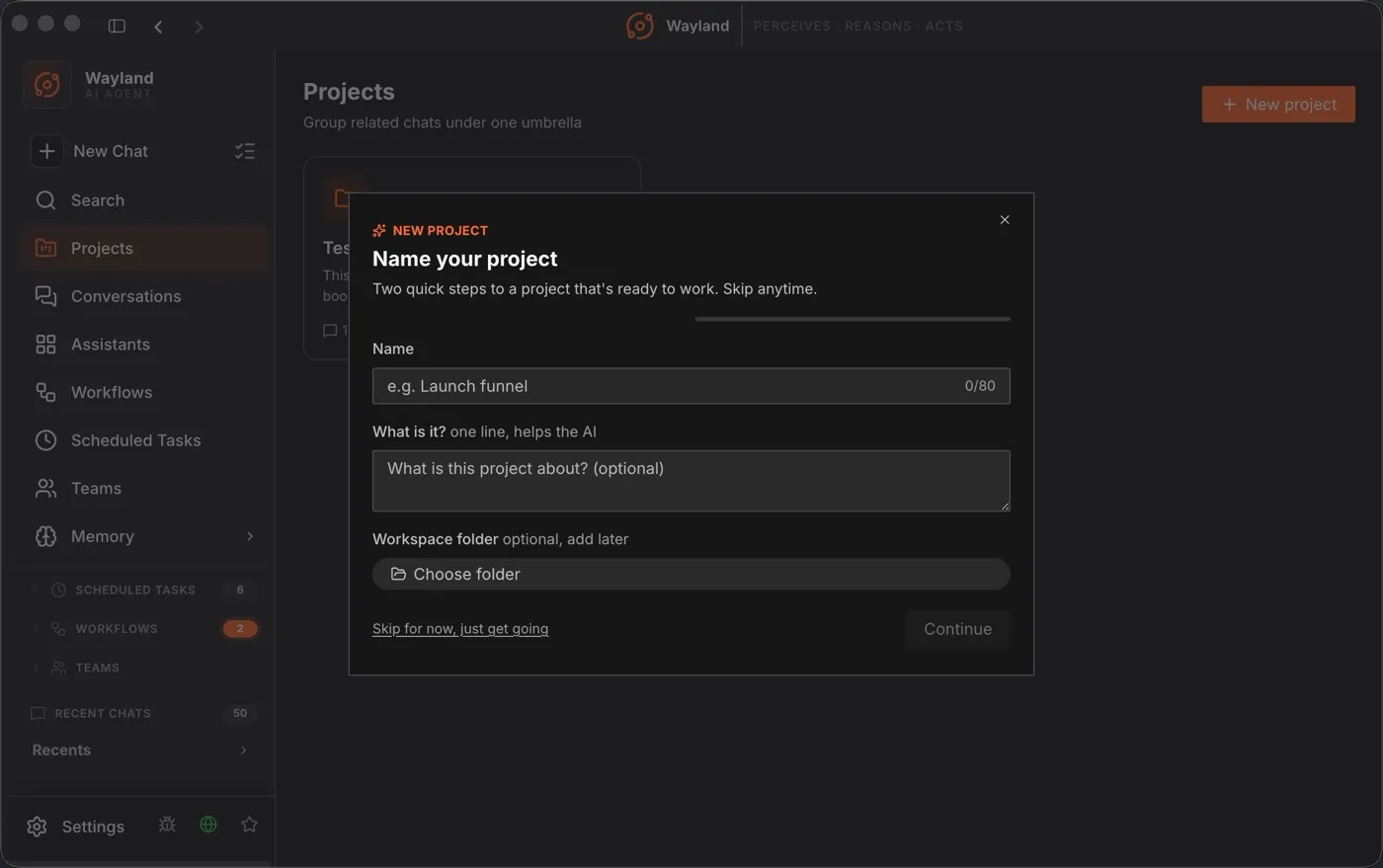
Projects that keep work moving. Organized, shared, ready to ship.
Organize your work across any agent you want, whether you are writing a book, building a website, launching a campaign, or creating a tool. Projects wrangle the moving parts so you actually get things done.
- ✓ Coordinate tasks, files, prompts, and outcomes in one place
- ✓ Shared project memory that stays with the work
- ✓ Upload notes, briefs, research, and supporting files
- ✓ Works across any agent doing the job
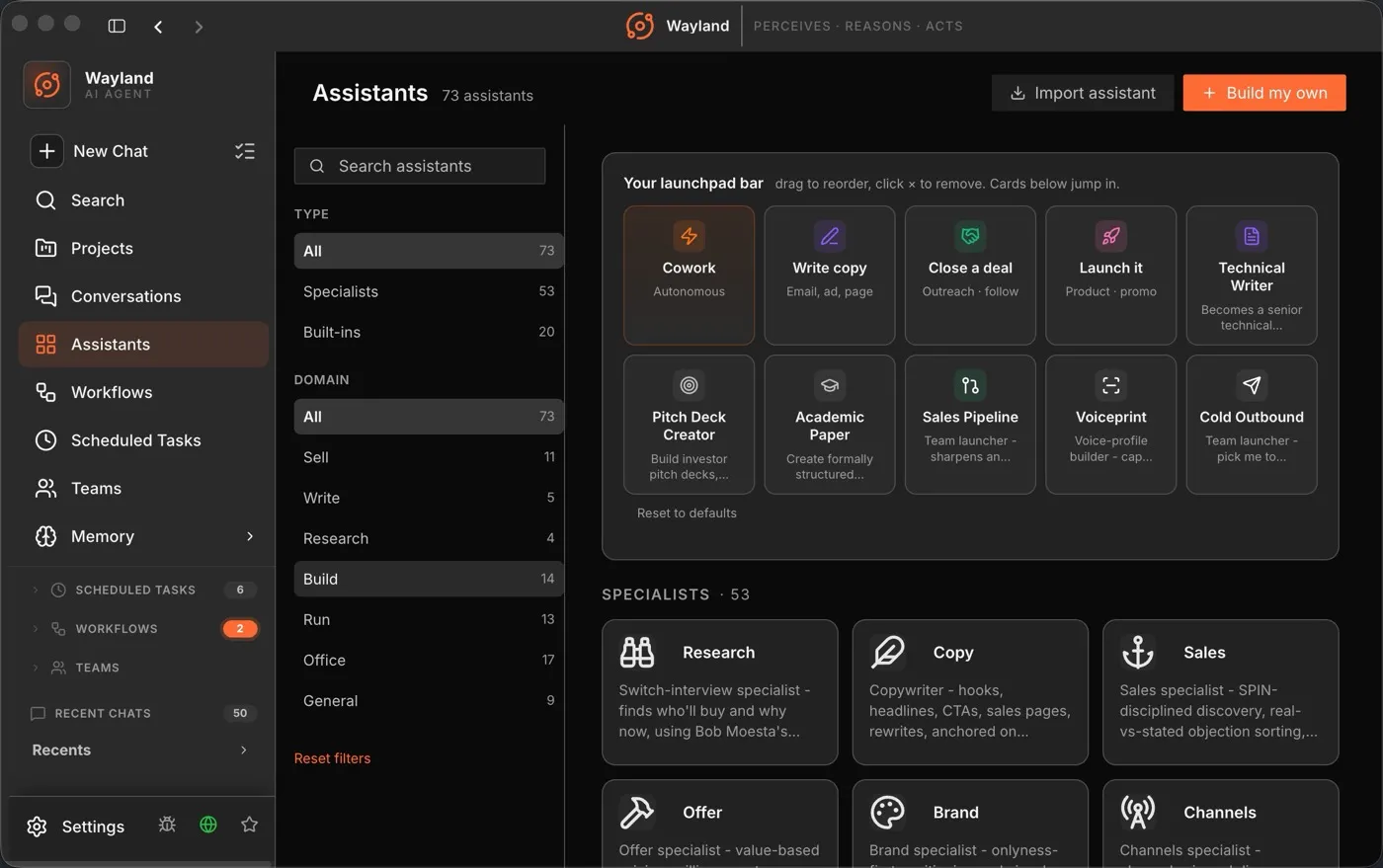
98 assistants. Actually useful. Built to get it done.
98 assistants pre-built with curated skill sets to help at every step, real specialists across research, writing, sales, operations, and strategy. Spin up your own in a few clicks, or lean on Cowork, the desktop co-pilot that grows with you.
- ✓ 98 pre-built assistants across every domain
- ✓ Build your own specialty-trained assistant in clicks
- ✓ Pin daily go-tos to a quick-launch bar
- ✓ Cowork evolves from intern to trusted co-pilot
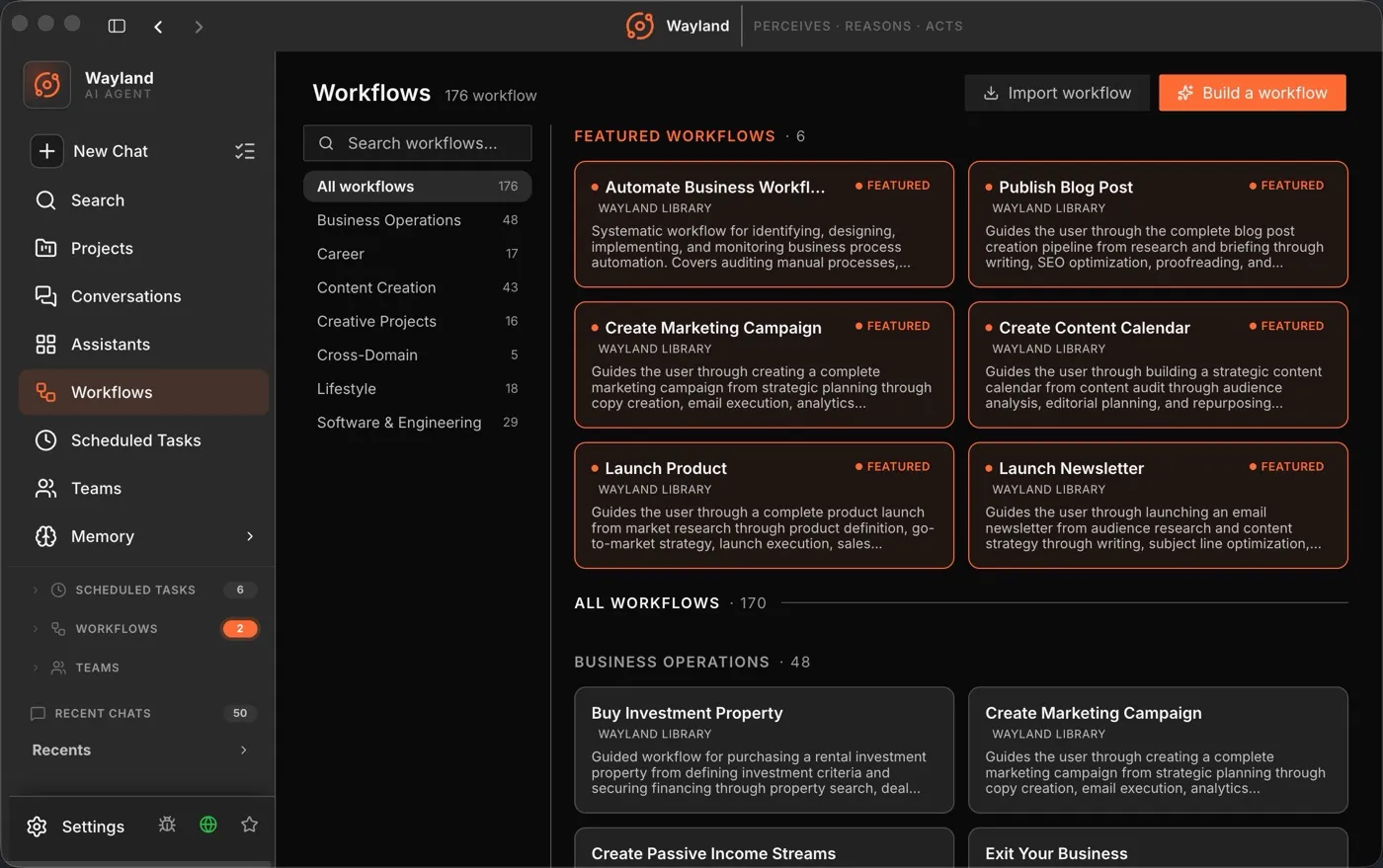
178 workflows. From idea to outcome.
178 ready-to-run workflows that take you from where you are to a finished outcome, one step at a time. Pick one and Wayland guides every step, activates the right specialist skills, adapts to your situation, and helps you ship faster.
- ✓ 178 workflows across Business, Content, Software, Creative
- ✓ Step by step to a defined end goal
- ✓ Adapts with the right questions at each step
- ✓ Run a step, the whole thing, or on autopilot
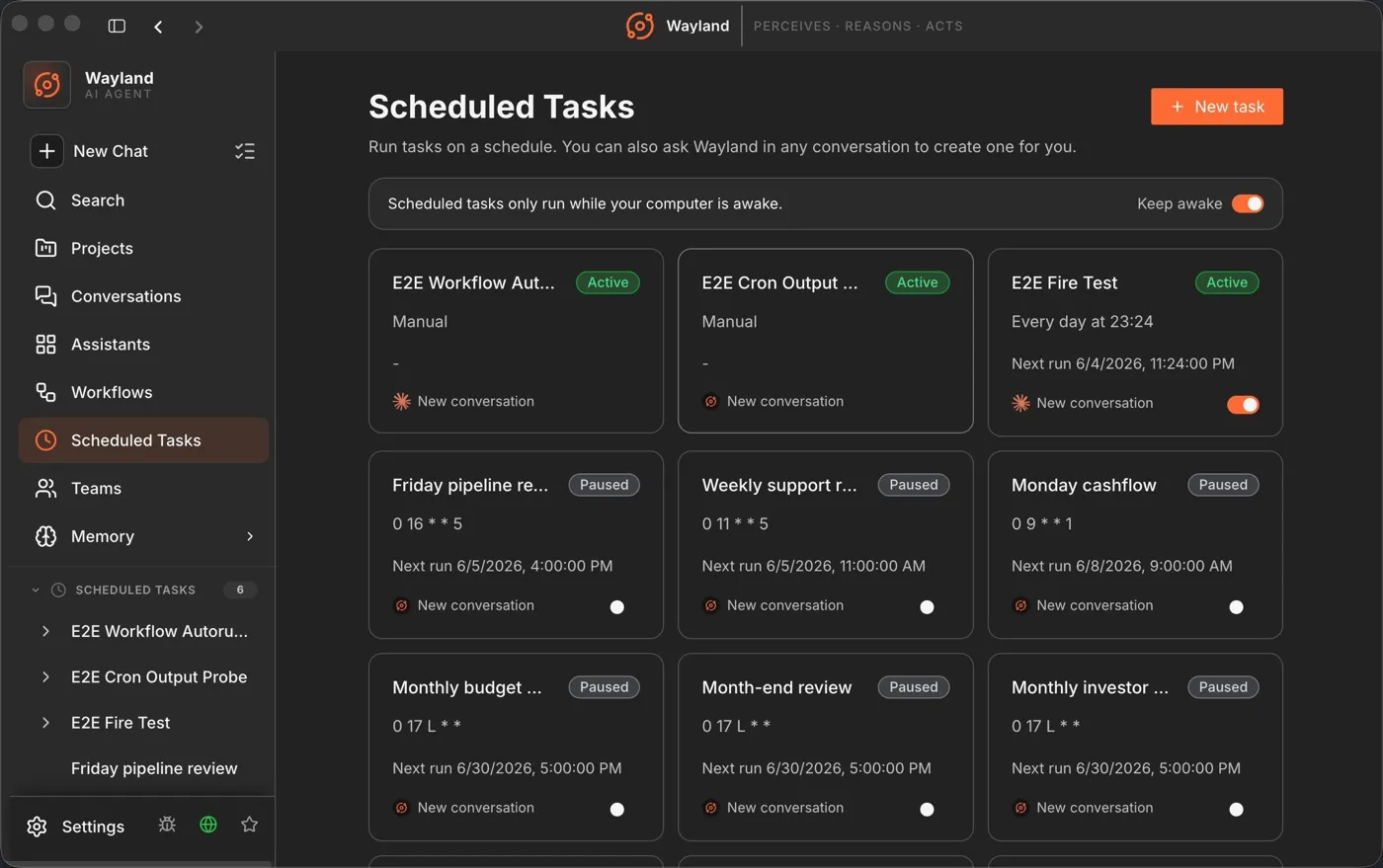
Scheduled tasks. Set it once, let it run.
Put Wayland on a schedule and the recurring work runs itself, daily, weekly, monthly, or month-end. Just ask in any chat to set one up, and each run lands in its own conversation with the output ready and waiting.
- ✓ Any schedule: daily, weekly, monthly, month-end, custom
- ✓ Create by just asking, or one click
- ✓ Runs real work: cashflow memos, pipeline reviews, standups
- ✓ Keep Awake so runs fire on time while you are away
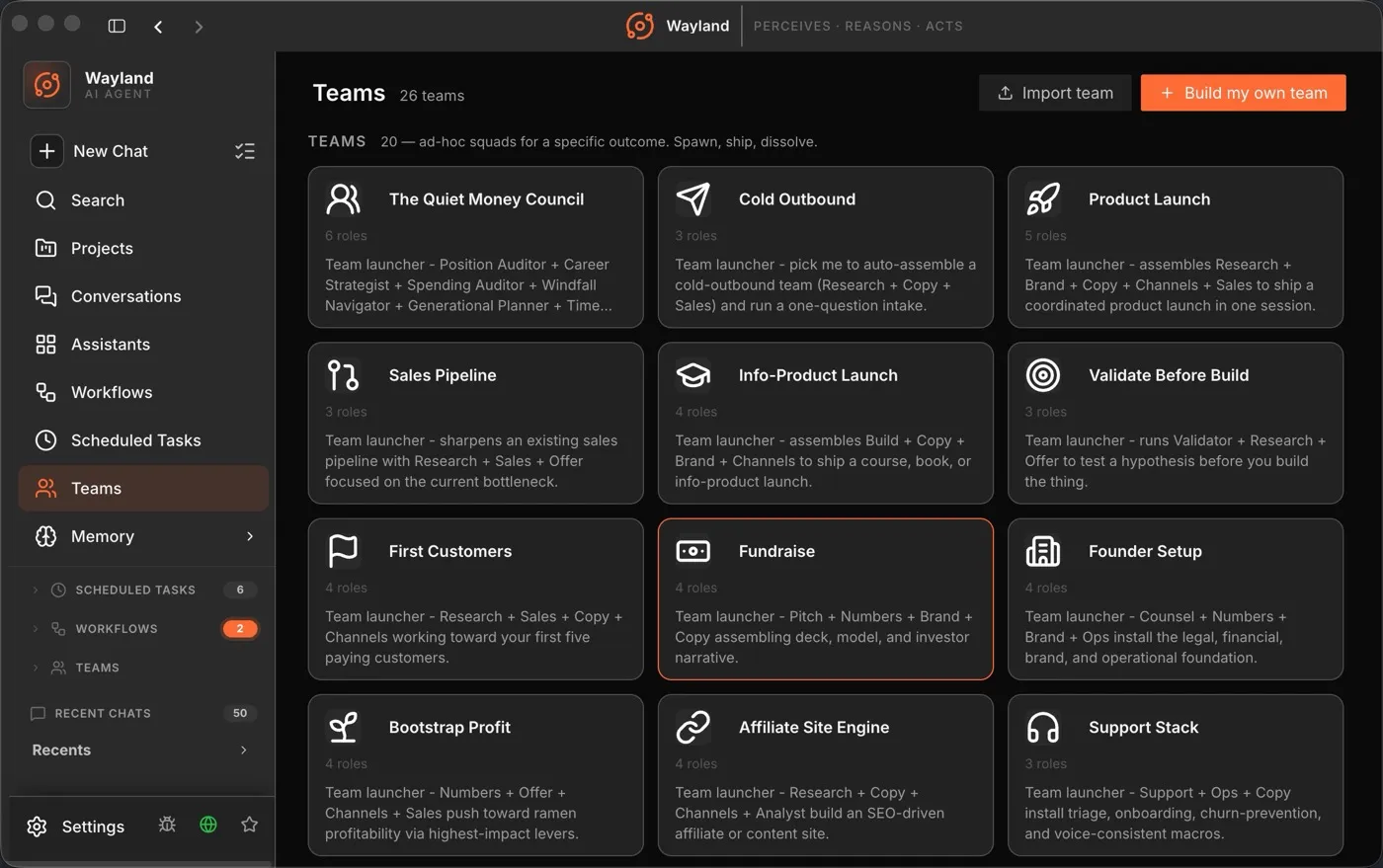
60 teams. Self-assembling specialists.
60 ready-made teams of AI specialists, each led by a team leader you talk to like a manager. They self-assemble around your goal and work autonomously against one shared blackboard until the job is done.
- ✓ 60 pre-built teams you coordinate through one chat
- ✓ Self-assembling: talk to one, the team orchestrates
- ✓ One shared blackboard keeps everyone aligned
- ✓ Ad-hoc squads or Standing Companies that run on
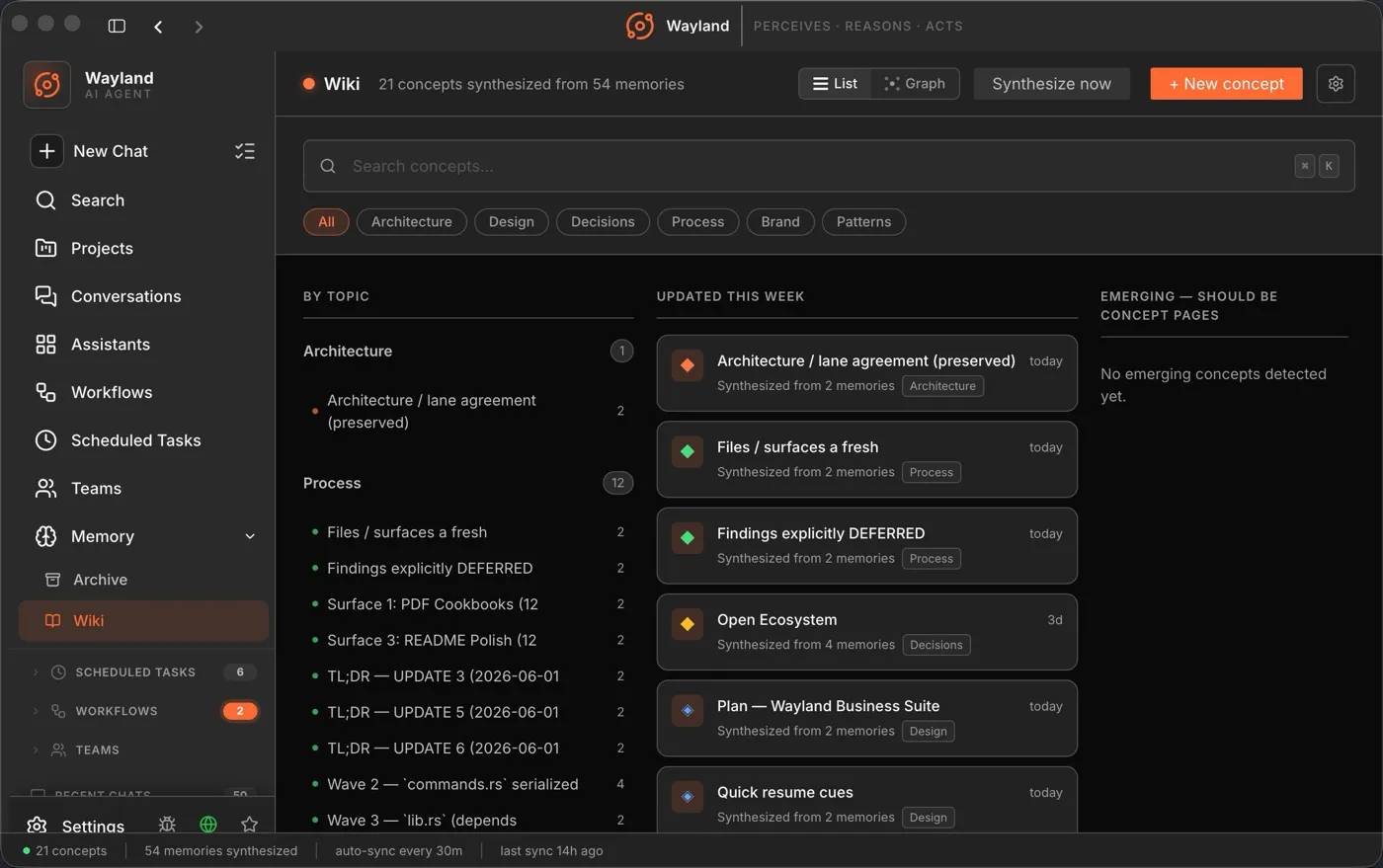
Shared memory. Learned, remembered, searchable.
Built on IJFW, our own memory infrastructure, released MIT and open source, every agent and system shares one unified memory, so the decisions you make and the preferences you teach it are remembered everywhere, for good. It synthesizes everything into a living wiki you can browse by topic and search in a keystroke.
- ✓ One shared memory across every agent and system
- ✓ A living, searchable wiki of your own knowledge
- ✓ A timeline of every decision you have made
- ✓ Import in a click, or drop files in a folder to learn them
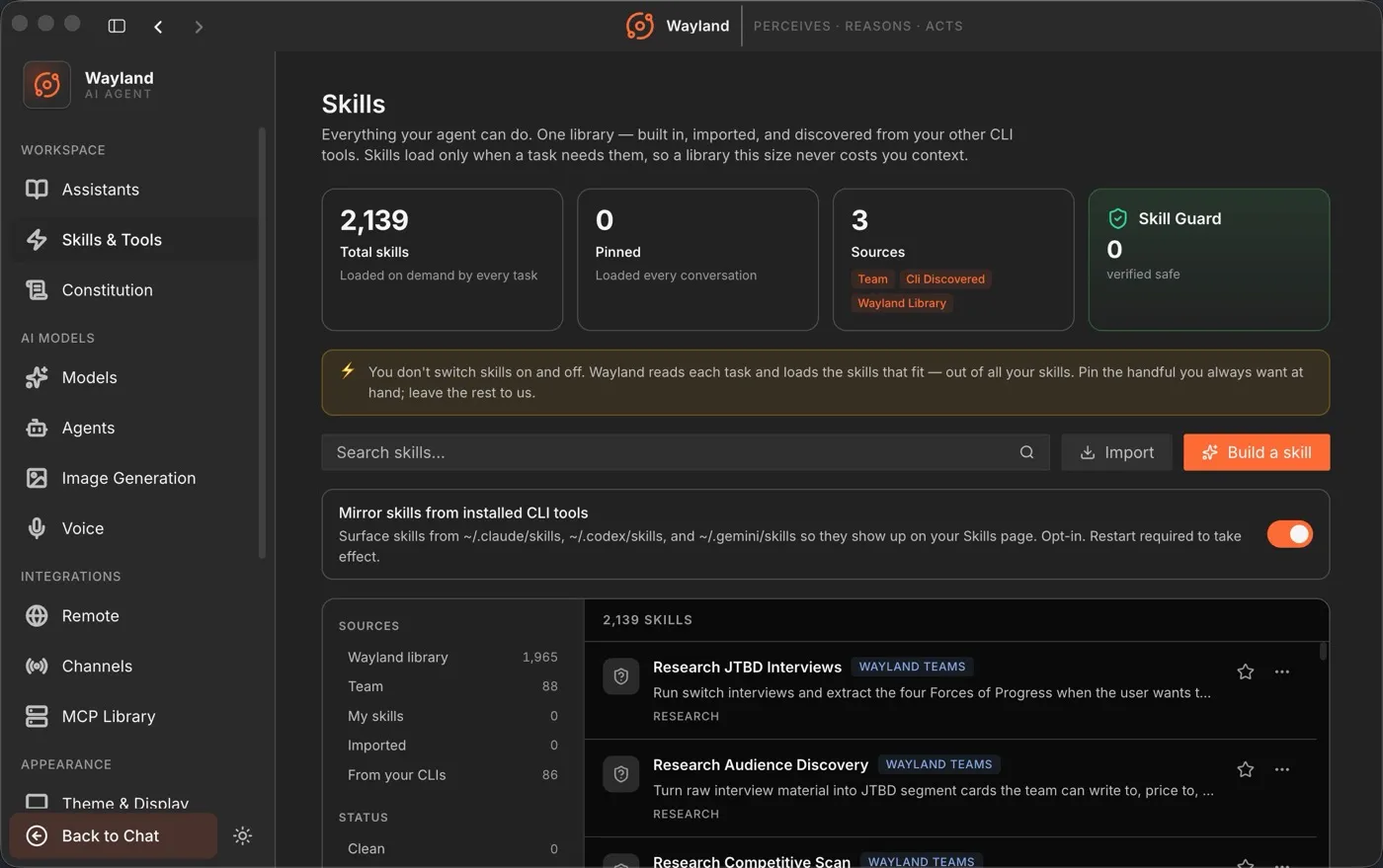
1,974 skills. Curated, not crowdsourced.
Skills are the expertise layer: 1,974 capabilities that turn any agent into a genuine domain specialist, with the proven method, tools, and best practices baked in. Wayland finds and loads the exact skill each task needs, on demand, across business, DevOps, marketing, finance, personal, and far more. Every one is first-party and hand-curated, reviewed and scrubbed by us before it ever shipped, and trusted by where it comes from rather than by a scan of code nobody vetted. Anything you bring in from outside goes through Skill Guard in full: rules plus an LLM read, and anything it blocks is quarantined and never loads. You are not installing off a marketplace and hoping.
- ✓ 1,974 skills, bundled offline and searchable from first launch
- ✓ Every one first-party and human-reviewed before it shipped, never a public marketplace
- ✓ Domain specialists across business, DevOps, personal and more
- ✓ Auto-loaded on demand, so a huge library never costs you context
- ✓ Import new skills or build your own anytime
The work comes out as work. Not as a wall of chat.
Ask most AI tools for a report and what you get back is a conversation you have to mine. Wayland treats a deliverable as a deliverable. Everything your chats and scheduled tasks produce lands as a real file in your workspace, in the format you actually asked for, listed with the run that made it. Open it, reveal it in your file manager, or save a copy straight into an email. Wayland keeps the record and never a second copy of your data, so the file sits exactly where the work happened and it is still yours the day you walk away. A recurring job builds a series rather than a pile: every run is kept under its own identity, so a retry or a second run never quietly destroys the one before it.
- ✓ Real files in real formats, opened with your own apps
- ✓ Every run of a recurring job kept, never overwritten by the next
- ✓ Provenance on each one: the task, the run, and a checksum
- ✓ Removing something from the list never touches the file on disk
- ✓ An agent's claim to have produced a file is checked against the disk before it counts

Everything running, in one place. Including what is waiting on you.
Autonomy is only comfortable when you can see it. Mission Control is the live board for every task, scheduled job and team run at once, ordered by what needs you first: blocked on your decision, then active, verifying, scheduled, done. Each job carries its own heartbeat, retry count, next run and pass or fail verdict, so one that quietly stalled reads as stalled instead of being assumed fine. Pop the board out into its own window and leave it open beside your work. The Cost tab is the other half of the same idea: set a limit by scope and period, choose whether reaching it warns you or pauses the work, and a run that hits the ceiling stops and asks instead of spending straight through it. A number you read afterwards is a report. This is a control.
- ✓ One live board across chats, scheduled tasks and team runs
- ✓ Whatever is blocked on your decision surfaces first, and says what it is waiting for
- ✓ Heartbeat, retries, next run and verdict on every job
- ✓ Budgets by scope and period that warn or pause at your limit
- ✓ Pop it out into its own window and keep it open while you work